
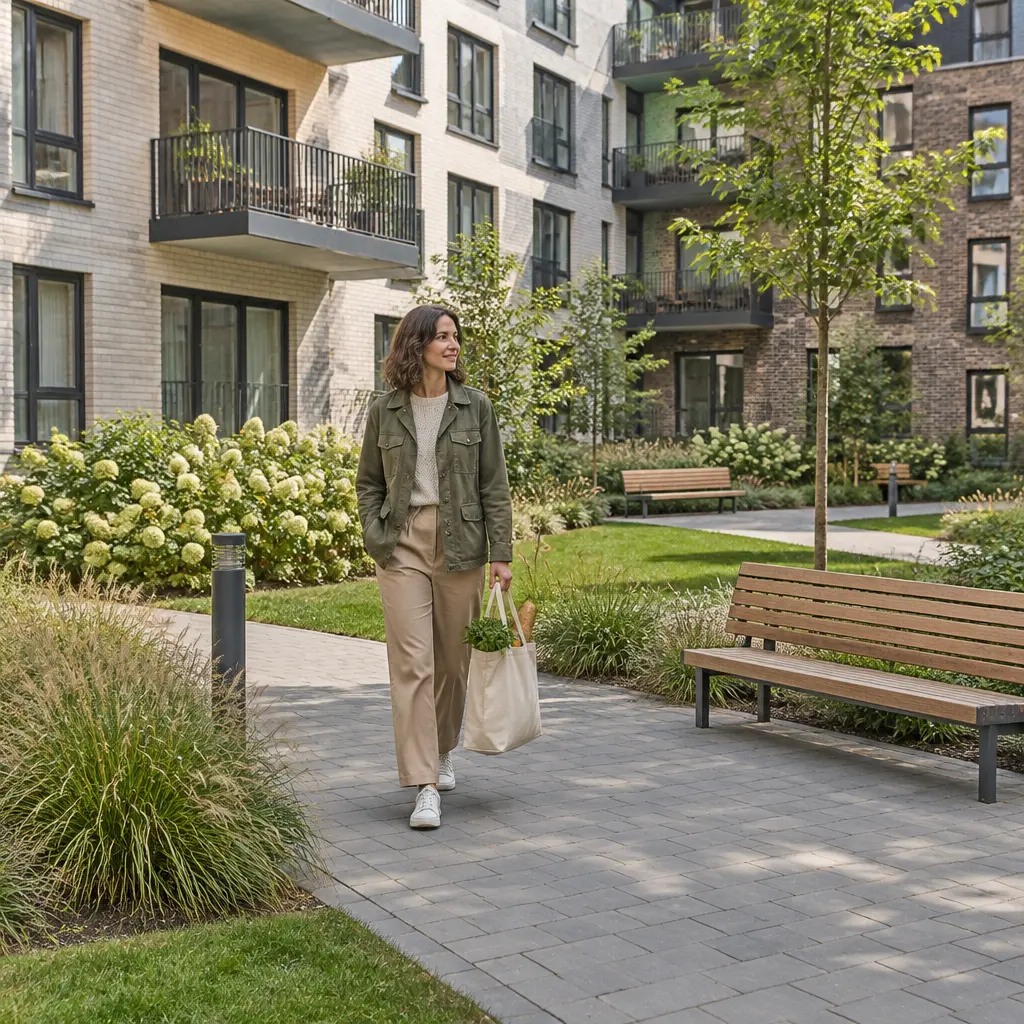
Apartment living in the city means making a private home within a larger residential building and a connected urban neighborhood. Its everyday perks often include shorter trips to work and amenities, access to shared services, and less responsibility for maintaining a detached property—but the value depends on location, cost, building quality, and personal needs. U.S. Census Bureau data show that roughly one-third of U.S. households rent, making rental housing a major part of everyday life. Below, we look at how location, shared amenities, maintenance arrangements, and community shape the practical advantages of city apartment living, while noting the trade-offs that renters should weigh.
City Apartment Living and Location Convenience
Location convenience is the reduction in time, effort, or expense needed to reach common destinations such as work, shops, parks, schools, and healthcare. The U.S. Environmental Protection Agency describes “location efficiency” as the relationship between where people live and the transportation options available to them. In city apartments, that relationship can make daily routines easier when homes are close to destinations and served by useful transit, walking, and cycling routes.
The benefit is not simply living in a dense neighborhood: it is having practical access to the places a resident actually uses. The U.S. Census Bureau’s American Community Survey tracks commuting methods and travel times, illustrating how strongly travel patterns vary by place. A short distance on a map may still mean a difficult trip if a route is unsafe, transit is infrequent, or accessibility is limited.
Walkability and Daily Errands
Walkability describes how readily people can reach everyday destinations on foot, taking into account distance, street design, crossings, and the pedestrian environment. In a well-connected city neighborhood, errands such as buying groceries, collecting a prescription, or visiting a café may fit into a walk rather than requiring a separate car journey. The U.S. Centers for Disease Control and Prevention notes that activity-friendly communities can support routine physical activity by making walking and cycling practical options.
These advantages are neighborhood-specific. Renters can assess them by checking actual walking routes, crossing conditions, lighting, and the hours of nearby services—not just relying on a listing’s distance estimates. For residents with mobility needs, step-free routes, curb cuts, elevators, and accessible businesses are essential parts of convenience.
Transit Access and Car-Light Living
Transit access is the practical availability of public transportation from a home, including the distance to stops, service frequency, operating hours, and connections. A city apartment near dependable buses, trains, or rapid transit may let a household reduce driving or manage without owning a car. That can avoid costs such as fuel, parking, insurance, maintenance, and loan payments, although transit fares and occasional rides still add up.
The U.S. Department of Transportation’s National Household Travel Survey documents how households use different modes and how travel varies by location and circumstance. Before choosing an apartment, residents can test a likely commute at the time they would actually travel and check late-night, weekend, and disruption alternatives. When a location makes routine trips easier, the next everyday advantage often comes from services inside the building itself.
Apartment Amenities and Shared Services
Apartment amenities are facilities or services provided for residents in addition to the private dwelling. They may include laundry rooms, fitness spaces, bicycle storage, package rooms, lounges, outdoor areas, or controlled building entry. Their usefulness depends on access, condition, operating rules, and whether their cost is included in rent or charged separately.
Shared facilities can make some routines more convenient without requiring every household to buy, store, or maintain the same equipment. However, an advertised amenity is not automatically a meaningful benefit: residents should confirm availability, fees, opening hours, accessibility, and how the building handles repairs or closures.
Laundry, Package Rooms, and Everyday Tasks
Practical amenities are services that help residents complete recurring household tasks. On-site laundry can save trips to a laundromat, while a secure package room or staffed reception can make deliveries easier to manage. These conveniences matter most when they work reliably and suit residents’ schedules.
A package room, for example, may reduce missed deliveries, but it does not guarantee that parcels are secure or available around the clock. Renters should ask how deliveries are logged, what happens when a room is full, and whether laundry machines require payment through an additional service. Everyday value comes from dependable operation rather than a long amenity list.
Fitness Rooms, Common Areas, and Outdoor Space
Recreational amenities are shared spaces intended for exercise, relaxation, or social activity. A fitness room may reduce the need for a separate gym trip, while a courtyard, roof deck, or resident lounge can offer useful space beyond a private apartment. These areas can be especially helpful in smaller homes, where indoor space is limited.
Their practical value depends on crowding, cleanliness, accessibility, noise rules, and maintenance. A shared gym does not replace a nearby park for everyone, and an outdoor deck may be unavailable during repairs or restricted hours. Prospective residents can ask current tenants how often these facilities are usable and whether amenity fees are built into the rent.
Apartment Maintenance and Predictable Responsibilities
Maintenance arrangements are the division of responsibility between a renter and a housing provider for repairs, upkeep, and building systems. In many rental homes, the landlord or property manager is responsible for major repairs and shared infrastructure, subject to local law and the lease. This can spare residents from organizing some large-scale work themselves, but renters remain responsible for understanding their duties and promptly reporting problems.
The U.S. Department of Housing and Urban Development advises tenants to understand lease terms, document housing conditions, and communicate repair needs. Rules differ across jurisdictions, and a landlord’s responsibilities may depend on the issue and local requirements. Apartment living is therefore not “maintenance-free”; its advantage is often that building-level tasks are coordinated by a manager rather than handled independently by each household.
Repairs and Building Systems
Building-system maintenance covers shared or essential components such as plumbing, heating, elevators, roofs, and common electrical systems. When a property manager responds effectively, residents may have a clear route for arranging repairs and can avoid finding and supervising specialists themselves. Service quality varies considerably between buildings, so a maintenance contact on paper is not enough to establish that repairs are timely.
Before signing, renters can ask how to submit requests, how urgent issues are handled outside business hours, and whether the building has recurring problems. They should also record existing damage at move-in and keep copies of written requests. Clear documentation helps distinguish routine wear from unresolved defects and supports more constructive communication.
Less Exterior Upkeep
Exterior upkeep includes tasks such as maintaining a yard, clearing shared walkways, arranging exterior repairs, and caring for building grounds. In many apartment settings, these responsibilities are managed collectively by the owner or building staff, potentially leaving residents with fewer outdoor chores than a homeowner would have. The precise arrangement depends on the lease and local housing practices.
This can be a meaningful time-saving benefit for people who travel frequently, have limited mobility, or prefer not to manage outdoor maintenance. It should not be confused with freedom from all household work: residents still handle their own interiors and may share responsibility for keeping common areas orderly under building rules.
Apartment Community and Urban Choice
Apartment community refers to the relationships and shared expectations that develop among residents in a building and its surrounding neighborhood. Shared spaces and repeated encounters can make it easier to recognize neighbors or participate in resident activities, while the wider city offers varied cultural, educational, and recreational destinations. These are opportunities rather than guarantees; privacy, turnover, building design, and individual preferences all influence social life.
The American Psychological Association has described social connection as relevant to health and well-being, but proximity alone does not create meaningful relationships. A welcoming common area, accessible community programs, and respectful building management may help residents feel more connected. The same urban setting also offers choice: residents can select among different neighborhoods, housing types, and nearby services, provided that rents and availability fit their circumstances.
Neighbor Contact and Shared Spaces
Neighbor contact is the everyday interaction residents have with people who live nearby. A lobby, courtyard, or shared laundry room can create low-pressure opportunities to exchange greetings or practical information. Resident events and building communication channels can also help people learn about local services and organize shared activities.
Shared living requires consideration as well as connection. Quiet hours, guest policies, security practices, and clear procedures for reporting concerns help balance sociability with privacy. Renters can ask how building notices are shared and whether common areas are maintained in ways that support different ages and access needs.
Access to Culture, Services, and Choice
Urban access is the range of services and activities available within a city, including libraries, medical providers, restaurants, parks, public programs, and cultural venues. Living near these destinations can broaden everyday options and make it easier to plan activities without a long drive. The benefit depends on affordability and genuine access: a nearby service is less useful if it is inaccessible, unavailable, or outside a household’s budget.
For example, a resident may combine a transit commute with a grocery stop or visit a public library on the way home. Such routines can save time when destinations align with daily travel. At the same time, urban housing can bring trade-offs, including noise, limited private outdoor space, higher rents in desirable areas, and competition for parking. Comparing the full monthly cost and the lived experience of a neighborhood is more useful than judging an apartment by location alone.
Conclusion: Weighing the Everyday Perks
City apartment living can combine location convenience, shared amenities, coordinated maintenance, and access to a broad range of urban services. Walkability and transit may simplify routine travel; useful building facilities can reduce household errands; and property management may take some exterior and building-system work off residents’ hands. Shared spaces can also create opportunities for neighbor contact, while city neighborhoods provide choices in work, recreation, and services.
These perks depend on the specific apartment and neighborhood, and they must be weighed against rent, fees, noise, space, accessibility, and service quality. Before choosing a home, test the commute, inspect common areas, review the lease and additional charges, and ask residents about repairs and building rules. For further context, consult local tenant-rights agencies, transit authorities, and neighborhood planning resources alongside the sources below.
Sources: U.S. Census Bureau, American Community Survey, https://www.census.gov/programs-surveys/acs; U.S. Environmental Protection Agency, Location Efficiency and Housing Affordability, https://www.epa.gov/smartgrowth/location-efficiency-and-housing-affordability; Centers for Disease Control and Prevention, Physical Activity: Built Environment Approaches, https://www.cdc.gov/physical-activity/php/about/physical-activity-built-environment-approaches.html; U.S. Department of Transportation, National Household Travel Survey, https://nhts.ornl.gov/; U.S. Department of Housing and Urban Development, Renting: Fair Housing and Tenant Rights, https://www.hud.gov/topics/rental_assistance/tenantrights; American Psychological Association, The Risks of Social Isolation, https://www.apa.org/monitor/2019/05/ce-corner-isolation