
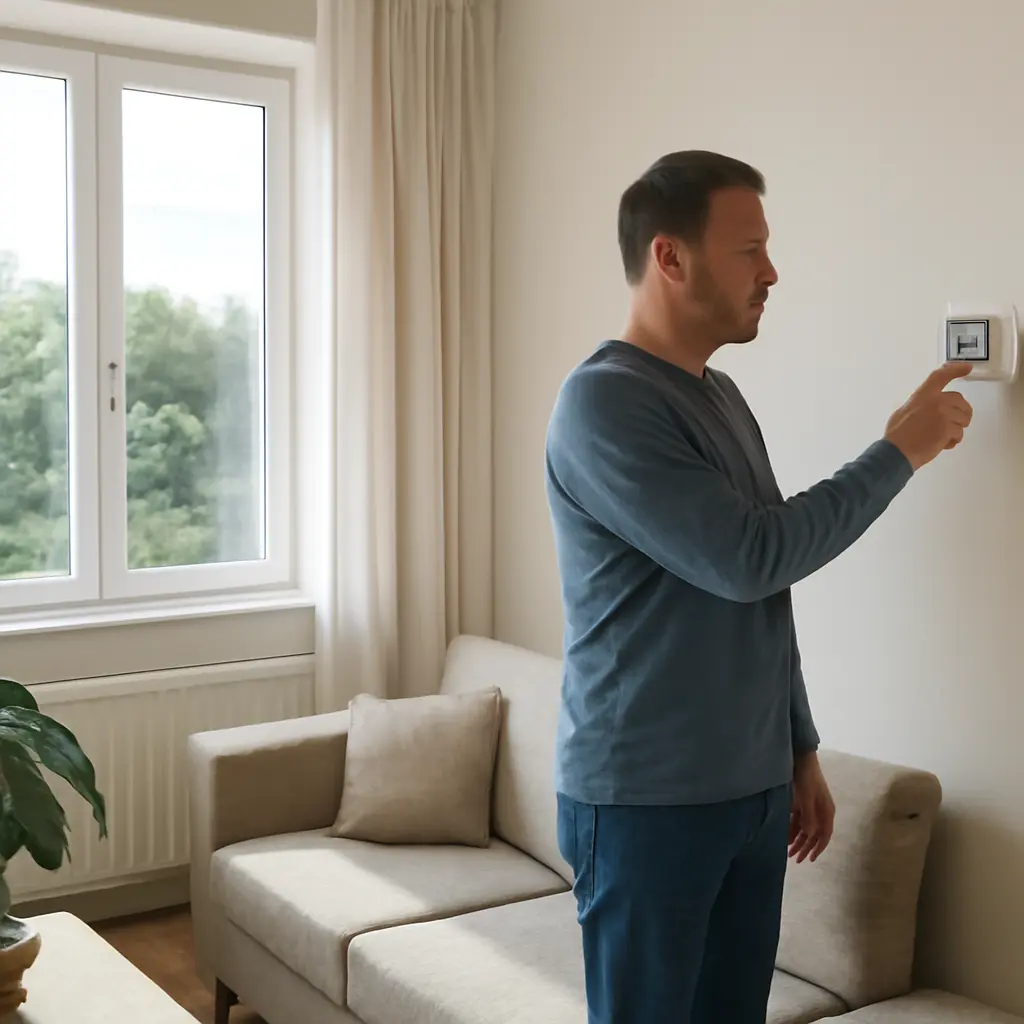
A thermostat is a control that senses indoor temperature and signals a heating or cooling system to maintain a chosen setting. It can change an apartment’s environmental impact by reducing unnecessary heating and air-conditioning, but the size of the benefit depends on the apartment, the equipment, the local electricity supply, and whether residents can control the system. The U.S. Department of Energy says adjusting a thermostat by 7–10°F (about 4–6°C) for eight hours a day can save up to 10% a year on heating and cooling costs in some homes; that figure is a potential, not a guaranteed apartment-level emissions reduction. Understanding thermostat settings, schedules, equipment, and renter constraints helps show when a small adjustment matters—and when it does not.
How thermostat control affects apartment environmental impact
A thermostat affects energy use indirectly: it tells a heating, ventilation, and air-conditioning (HVAC) system when to run, while the building envelope, system efficiency, weather, and occupants determine how much energy is needed. The U.S. Environmental Protection Agency’s ENERGY STAR program describes a smart thermostat as a device that can help manage heating and cooling schedules and reduce energy use when a home is unoccupied or asleep. That does not mean every thermostat or every temperature change produces the same savings.
The environmental outcome is usually considered through operational energy and associated greenhouse-gas emissions. A thermostat may lower fuel use in an apartment with its own gas furnace, or electricity consumption in a unit served by an electric heat pump or air conditioner. In centrally heated buildings, however, an individual apartment thermostat may have limited influence over the building’s total energy use. The International Energy Agency identifies buildings as a major source of global energy demand and emissions, making efficient operation relevant alongside insulation, equipment upgrades, and cleaner energy.
Setback and set-up: changing the target temperature
A temperature setback lowers the heating target when occupants are away or asleep; a temperature set-up raises the cooling target during those periods. The Department of Energy’s guidance—adjusting the setting by 7–10°F for eight hours daily—offers a practical benchmark for homes where occupants can control their own heating and cooling. Savings vary with climate, the starting temperature, building insulation, system type, and how long the setting is changed.
A thermostat does not save energy simply because its display shows a lower number. In winter, a lower indoor target generally slows heat loss to outdoors; in summer, a higher target generally reduces heat entering the space and the need for cooling. But residents should avoid unsafe temperatures, protect plumbing from freezing, and consider health needs. In apartments, a building’s heating policy or shared system may also restrict the settings available.
Scheduling and occupancy-aware control
Programmable and smart thermostats use schedules, sensors, or occupancy information to adjust temperatures without relying on residents to remember each change. ENERGY STAR certification evaluates connected thermostats using field data and performance requirements; the program states that certified models are independently verified for energy savings potential. Features such as geofencing and learning schedules can be useful, but their benefits depend on accurate settings and compatible HVAC equipment.
A schedule is most useful when apartment routines are predictable and the thermostat controls the equipment serving that apartment. For a shared system, a schedule set by one resident may have little effect—or may affect neighbors—so building-level controls and clear operating rules matter. A simple programmable schedule can also be effective without app-connected features.
Which thermostat and HVAC combinations matter most
The thermostat’s environmental influence depends on what it controls. A device connected to a dedicated furnace, boiler zone, heat pump, or air-conditioning system can respond directly to an apartment’s temperature setting. A thermostat that only controls a fan, or one that is disconnected from the central plant, may have little impact on total heating or cooling energy. The U.S. Department of Energy recommends checking equipment compatibility before replacing or reconfiguring controls.
Individual systems: furnaces, boilers, and heat pumps
In an individually metered apartment, a thermostat can influence the unit’s energy use and often the resident’s utility bill. With a gas furnace or boiler, reduced heating demand can reduce fuel consumption. With a heat pump, efficient operation depends on the system and climate; aggressive temperature changes may prompt auxiliary electric resistance heat in some installations, which can use substantially more electricity than the heat pump itself. Follow the manufacturer’s guidance and avoid assuming that one setback strategy fits every system.
For air conditioning, raising the cooling target while away can reduce compressor runtime, provided the apartment remains within a safe and comfortable range. Fans can improve perceived comfort but do not cool a room in the same way as air conditioning; turn them off in empty rooms where practical. These operational choices complement, rather than replace, maintenance such as clean filters and properly functioning equipment.
Central building systems and shared controls
In many apartment buildings, boilers, chillers, or heat pumps serve multiple units. A resident may control a radiator valve or fan-coil thermostat, but the central plant’s schedule and temperature limits are often managed by the property owner. In that arrangement, local controls can improve comfort and reduce overheating, yet the effect on building-wide emissions depends on how the system responds and whether energy use is separately measured.
This is why thermostat changes should be paired with building-level action: commissioning controls, balancing heating distribution, insulating pipes, and upgrading central equipment can address waste that an individual tenant cannot reach. The U.S. Environmental Protection Agency’s ENERGY STAR building resources emphasize energy management at the whole-building level, a useful complement to unit-level adjustments.
Limits, trade-offs, and renter considerations
Thermostat control is a practical efficiency measure, not a stand-alone climate solution. A poorly insulated apartment can lose heat rapidly, an inefficient air conditioner can consume substantial electricity, and a carbon-intensive grid can make each unit of electricity more emissions-intensive. Conversely, an efficient heat pump supplied by a cleaner electricity mix may deliver heating with lower emissions than direct fossil-fuel combustion. Emissions estimates therefore require both energy-use data and the relevant local fuel or electricity emissions factors.
Comfort, health, and indoor conditions
The best setting is not necessarily the lowest heating target or highest cooling target a resident can tolerate. Older adults, infants, people with chronic conditions, and residents exposed to extreme outdoor temperatures may need tighter indoor temperature limits. Humidity, ventilation, and indoor air quality also matter; reducing HVAC runtime should not compromise necessary ventilation or create dampness and mold risks.
Residents should use safe, locally appropriate settings and consult a clinician or public-health guidance when health conditions affect temperature needs. If the apartment overheats because of central heating, report the issue to building management rather than opening windows for long periods while the heating system continues to run. That response can waste energy without solving the underlying control problem.
Leases, permissions, and split incentives
Renters may not be allowed to replace a thermostat, access a boiler, or change a building-wide schedule. Even where a tenant pays the utility bill, the property owner may control insulation and equipment upgrades; where utilities are included in rent, residents may have little financial incentive or control. This split between who pays and who makes building decisions can limit the impact of individual action.
Before changing equipment, check the lease and ask the landlord or building manager about compatibility, wiring, and permission. A renter can still ask for a thermostat schedule, maintenance, radiator controls, weatherization, or an energy audit. These steps can reveal whether the main opportunity is occupant behavior, equipment operation, or a building improvement.
How to estimate the impact in your apartment
A credible estimate starts with the energy source and the bill, not a generic savings claim. Compare heating or cooling energy use across similar weather periods, account for changes in occupancy, and distinguish electricity used by HVAC from other household electricity where possible. Utility bills often provide monthly consumption, while smart meters or equipment monitors may show finer-grained patterns.
- Identify whether the thermostat controls equipment dedicated to your unit or a shared building system.
- Record the existing schedule and temperature settings, then make a modest, safe adjustment during predictable away or sleep periods.
- Compare energy use over multiple weeks or billing periods with similar outdoor temperatures; a single bill is not enough to establish causation.
- For an emissions estimate, multiply the energy change by the appropriate emissions factor for the fuel or local electricity supply.
- Ask building management about system efficiency, control limits, maintenance, and opportunities for whole-building improvements.
A useful chart for an apartment assessment would plot daily or monthly heating and cooling energy against outdoor temperature, marking when thermostat schedules changed. Such a chart can help distinguish a genuine operational improvement from seasonal weather variation. It should be treated as an estimate rather than proof unless the comparison controls for occupancy, equipment changes, and other relevant factors.
Conclusion: thermostat choices can help, but building context decides how much
A thermostat can reduce an apartment’s environmental impact when it meaningfully controls heating or cooling and avoids unnecessary operation. Setbacks, schedules, and occupancy-aware controls can help, while equipment type, shared-system design, local energy emissions, comfort, and renter permissions determine the scale of the result. The Department of Energy’s potential savings benchmark is a useful starting point, not a promise for every apartment.
Residents can begin with a safe schedule adjustment, check whether their thermostat controls the relevant equipment, and review energy use over comparable periods. They can also ask landlords to address overheating, improve controls, and invest in insulation and efficient HVAC systems. The largest gains often come when sensible thermostat use is combined with better buildings and cleaner energy.
Sources: U.S. Department of Energy, “Programmable Thermostats,” https://www.energy.gov/energysaver/programmable-thermostats; ENERGY STAR, “Smart Thermostats,” https://www.energystar.gov/products/smart_thermostats; International Energy Agency, “Buildings,” https://www.iea.org/topics/buildings; U.S. Environmental Protection Agency, “ENERGY STAR Portfolio Manager,” https://www.energystar.gov/buildings/benchmark; U.S. Department of Energy, “Heat Pump Systems,” https://www.energy.gov/energysaver/heat-pump-systems